

Invert Sugar for Bees: What the Science Actually Says

Invert sugar for bees: what science says about better bee nutrition
Over the last twenty-five years, the way we keep and feed bees has changed profoundly. Unstable climate patterns, discontinuous blooms, and the diversification of beekeeping operations — from queen rearing and nucleus production to pollination services — have made colony nutrition more critical than ever before. In this context, the question of whether to use invert sugar for bees is no longer academic. It is a practical decision with measurable consequences for colony health and survival.
This page summarizes what peer-reviewed research and field experience tell us about how enzyme-inverted syrup supports bee colonies — and where the real dangers lie in getting inversion wrong.
Key findings at a glance
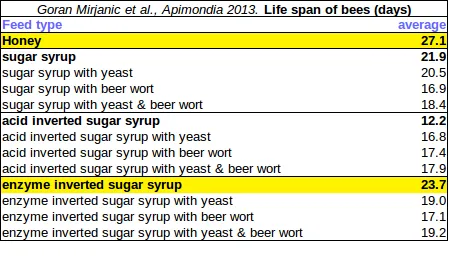
- Enzyme-inverted syrup produces the longest bee lifespan after honey (Mirjanic et al., Apimondia 2013)
- Acid-inverted syrup produces the shortest lifespan — less than half that of honey
- HMF from acid inversion is toxic above 150–250 mg/kg; enzyme inversion produces zero HMF
- Starch-based syrups cause midgut damage and comb granulation
What is invert sugar and why does it matter?
Sucrose — ordinary table sugar — is a disaccharide. Before bees can metabolize it, they must split it into its two component monosaccharides: glucose and fructose. The enzyme responsible for this conversion is called invertase, and the resulting sugar mixture is known as invert sugar.
What makes this mixture particularly effective as bee nutrition is that glucose and fructose serve complementary metabolic roles. Glucose enters glycolysis rapidly, providing immediate energy, while fructose requires an additional enzymatic conversion step, delivering slower, more sustained energy release. Together, they provide continuous energetic support — the same dynamic that makes honey such an effective natural food for the colony.
When beekeepers provide invert syrup for bees, the sucrose-to-monosaccharide conversion has already occurred. The bees can absorb the sugars directly, with less metabolic processing required.
The hypopharyngeal gland connection:
Why pre-inversion matters most when bees need it most
Here is a biological detail that changes the conversation entirely. Invertase is secreted by the hypopharyngeal glands — the same glands that produce royal jelly. These are dynamic, reversible organs whose activity depends directly on diet and colony social conditions.
When pollen is scarce, glandular activity drops. Young nurse bees produce less royal jelly, and older forager-age bees secrete less invertase. This creates a compounding problem: during dearth periods, bees are least capable of inverting sucrose themselves precisely when they most need easily digestible feed.
This is arguably the strongest biological argument for providing pre-inverted syrup. It is not simply a matter of convenience — it addresses a genuine physiological bottleneck that occurs during the most stressful periods of the colony cycle.
What the research shows: lifespan, gut health, and colony strength
The most comprehensive comparative study on bee feed types was presented at the Apimondia 2013 congress by Goran Mirjanic et al. Their three-year study compared multiple feed types against acacia honey, measuring both average lifespan and intestinal health of bees:
The Short Answer: Enzyme-Inverted Syrup Outperforms Every Alternative
After honey, enzyme-inverted sugar syrup produced the longest average bee lifespan. Acid-inverted syrup produced the shortest — less than half that of honey.
On intestinal health, the findings were equally decisive: honey, plain sugar syrup, and enzyme-inverted syrup all showed no harmful effects on the midgut epithelial layer. The most serious intestinal damage was found consistently in bees fed acid-inverted syrup.
Three feed types compared: not all syrups are equal
The real market choice for beekeepers is not simply between "inverted" and "not inverted." There are three fundamentally different feed categories, each with distinct implications for colony health:
| Factor | Enzyme-Inverted Sucrose | Acid-Inverted Sucrose | Starch-Based Syrup |
| Sugar composition | Glucose + Fructose | Glucose + Fructose + HMF risk | Glucose + Maltose + Oligosaccharides |
| Digestibility | Excellent | Moderate (pH damage) | Poor — oligosaccharides not digested |
| HMF risk | None | High, especially when heated | Variable |
| Crystallization tendency | Low | Low | High — cells can granulate completely |
| Gut safety | Safe — no midgut damage | Most serious damage observed | Harmful — can cause diarrhea |
| Winter survival | Good | Poor | Losses observed, especially in harsh climates |
The HMF danger: why the inversion method is critical
The critical difference between enzyme inversion and acid inversion comes down to one compound: hydroxymethylfurfural (HMF).
Enzymatic inversion occurs at approximately 35°C and neutral pH, without altering sugar quality and without producing HMF. Acid inversion — using citric acid, tartaric acid, lemon juice, or vinegar at elevated temperatures — creates conditions where HMF forms rapidly. HMF is toxic to bees at concentrations above 150–250 mg/kg.
Research by Frizzera et al. (2020, Apidologie) demonstrated that acidified syrups heated above 50–60°C can reach HMF concentrations up to 14,000 mg/L — catastrophically lethal levels. The study also showed that syrup acidity itself is detrimental to bee survival, making acid-based inversion harmful on two fronts simultaneously.
As Italian apiculture expert Antonio Carrelli writes: before feeding bees homemade syrups "inverted" with lemon or vinegar, remember that the hive is a super-organism with precise physiological rhythms — not a kitchen experiment. In nature, bees do not consume lemon juice, banana, or garlic. Improvised nutrition can alter colony dynamics in ways that are difficult to reverse.
The rule is simple: when the pH drops and HMF rises, toxicity grows. Enzyme inversion avoids this entirely.
Practical economics
A common concern is cost. Our enzyme-based invertase formulations for on-farm syrup production start at approximately at €52 per ton of syrup — a modest investment that is broadly offset by the documented benefits to colony health and the avoidance of risks associated with alternative methods.
What this means for your operation
The combined evidence from intestinal health studies, lifespan data, overwintering trials, and HMF toxicology research points to a consistent conclusion: enzyme-inverted invert sugar for bees is the safest and most biologically appropriate supplemental carbohydrate feed available, particularly during periods of pollen scarcity when the bees' own invertase production is compromised.
It avoids the HMF toxicity of acid-inverted syrups. It avoids the oligosaccharide digestibility problems of starch-based feeds. And it delivers glucose and fructose in the same complementary balance that bees evolved to use.
Related Products
