

Sugar Syrup & Paste for Healthy, Productive Beehives: A Pro's Guide

U.S. beekeepers lost an estimated 55% of their managed honey bee colonies between April 2024 and April 2025 — the highest annual loss rate ever recorded. For professional beekeepers, the difference between thriving colonies and devastating losses often comes down to nutrition.
With climate change making nectar dearths more frequent and unpredictable, high-quality supplementary feeding is no longer optional. It is essential for maintaining healthy and productive beehives year-round. Sugar syrup and sugar paste are your two primary tools for this, but only when used correctly. This guide covers how to use them to ensure your colonies are healthy, productive, and resilient.
Sugar Syrup for Bees: Applications and Concentrations
Sugar syrup is a carbohydrate-rich feed that gives bees the energy they need for brood rearing, foraging, and comb building. The right concentration depends on what you're trying to accomplish.
Stimulation Feeding
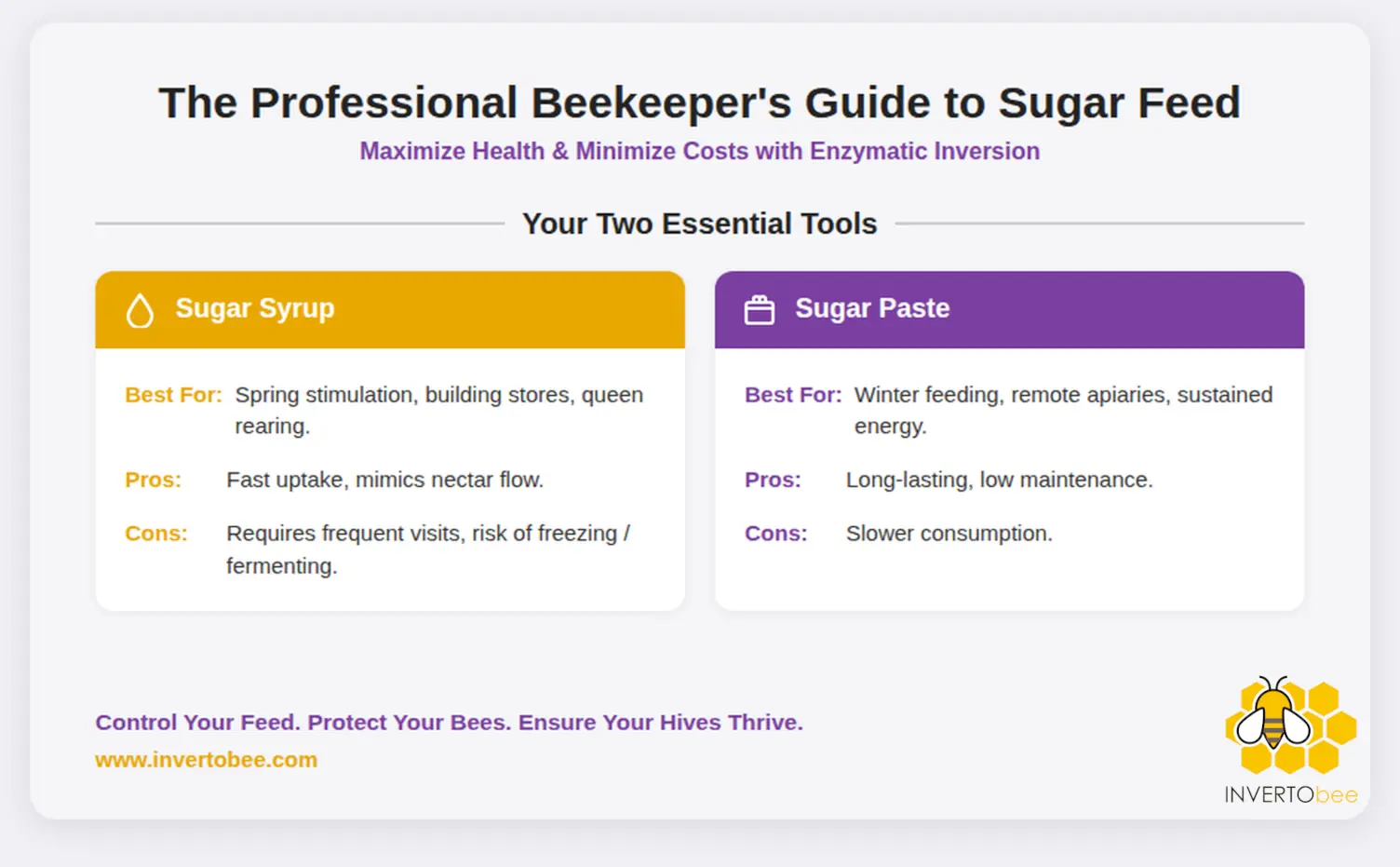
To stimulate colony buildup in spring or during queen rearing, feed small quantities — 1 to 2 liters every few days — at a 1:1 concentration of sugar to water by volume . This mimics a light nectar flow and pushes the colony to expand brood production.
Building Winter Stores
Winter preparation calls for a denser syrup. A 2:1 ratio of sugar to water gives bees the concentrated nutrition they need to build adequate winter reserves. Feed several liters weekly until the colony has stored enough processed sugar.
Supporting Queen Rearing
Queens mated in mini nucleus colonies need syrup whenever fresh nectar is scarce. Cell-raising colonies benefit from continuous sugar syrup feeding throughout the queen production season — it keeps stimulation high and maximizes the number of queen cells started.
Boosting Pollination Efficiency
Here's one that surprises many beekeepers: feeding sugar syrup can increase the number of field bees foraging for pollen. In crop pollination situations, pollen-collecting bees are often more efficient pollinators than nectar collectors. For crops that don't produce significant nectar, syrup stimulation can meaningfully increase overall pollination results.
Sugar Paste for Bees: The Practical Alternative
Sugar paste solves a specific problem: distance. When your apiaries are remote and you can't visit every few days, syrup becomes impractical. Sugar paste reduces the time interval required between visits.
You can supply 1 to 3 kilograms of sugar paste per hive, and it typically lasts at least 1 to 2 weeks. That's a real advantage for operations spread across multiple sites.
Why Sugar Paste with Invertase Cuts Feeding Costs
Using invertase in sugar paste to achieve sugar inversion reduces your feeding costs for three specific reasons:
- Less energy wasted by bees. Inverted sugar requires less metabolic energy for assimilation. Your bees consume less feed overall to get the same nutritional benefit.
- No hardening, no waste. Enzyme-treated sugar paste stays soft until the last gram is consumed. Without invertase, paste hardens over time and bees abandon it.
- Bees eat it all. Soft paste means bees don't throw pieces outside the hive — a common problem with untreated paste that wastes both feed and money.
Why Make Your Own Bee Feed with Invertase?
When you buy pre-made commercial bee feed, you're trusting someone else's ingredient list. You don't always know the sugar source, the inversion method, or whether the product contains additives your bees don't need. Making your own feed with our invertase enzyme puts you back in control.
- You choose the sugar. Plain white granulated beet sugar is the safest option for bees — they cannot properly digest the complex sugars and minerals found in raw sugar, brown sugar, or other kind of syrups. When you source your own sugar, you know exactly what's going into your hives.
- You choose the concentration. Need a light 1:1 syrup for spring stimulation? A heavy 2:1 for autumn stores? A sugar paste for remote apiaries in winter? With invertobee products, you make exactly the feed your colonies need at that moment — no compromise, no one-size-fits-all formulation.
- You control the process. Enzymatic inversion at mild temperatures means zero HMF risk. No acid. No excessive heating. You mix sugar, water, and Invertobee enzyme, and the invertase does the work — breaking sucrose into the glucose and fructose that bees absorb most efficiently.
For operations running hundreds or thousands of hives across different climates and forage conditions, this flexibility matters. A beekeeper preparing colonies for almond pollination in California has different feeding needs than one wintering bees in northern Europe. Off-the-shelf commercial feeds can't account for that. Your own enzyme-inverted feed can.
Invertobee: Practical Recipes with Costs
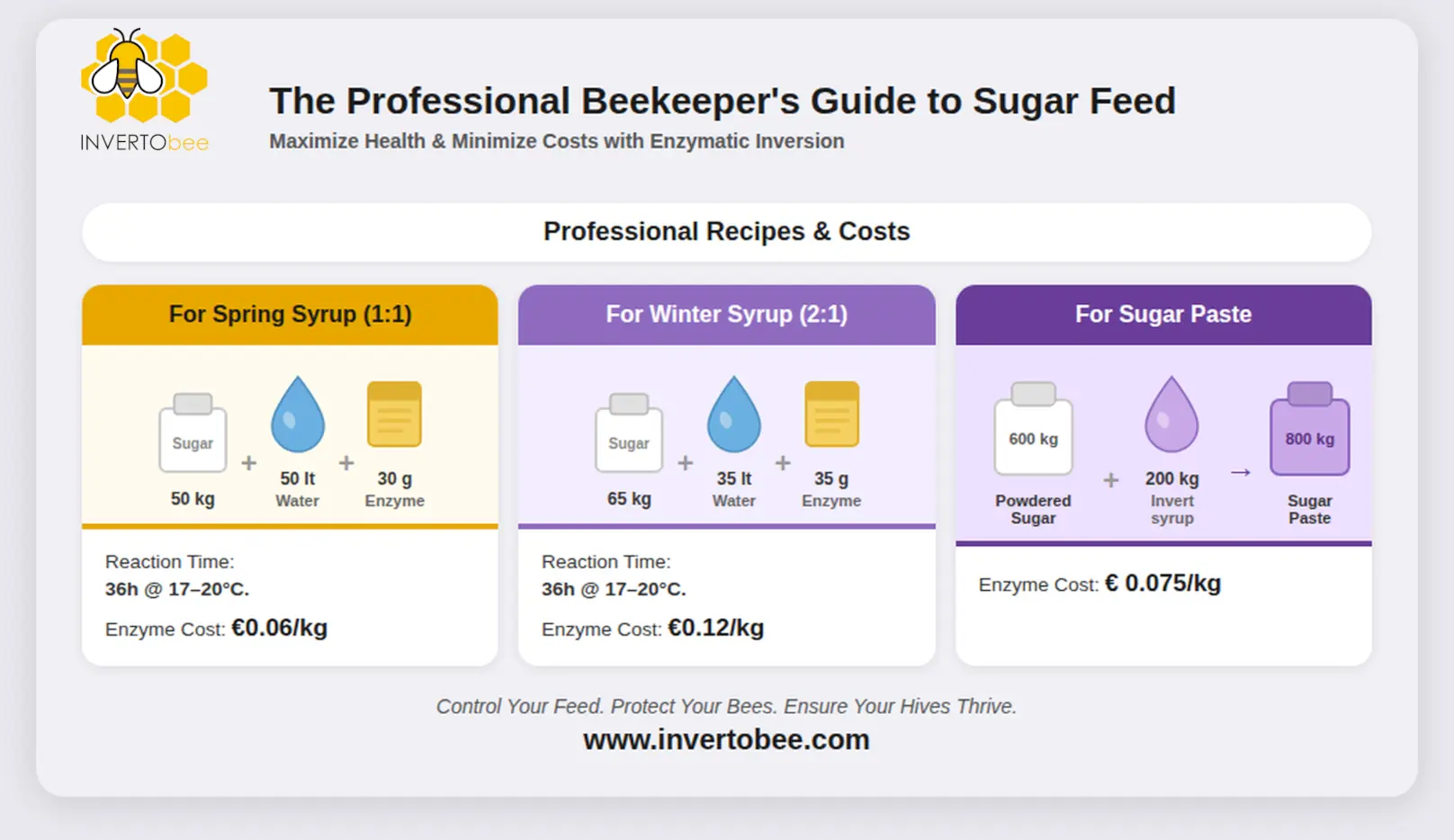
For Spring Stimulation (1:1 Syrup):
- Recipe: 50 kg sugar to 50 L water.
- Dosage: Use 30g of invertobee 50-C.
- Reaction Time: ~36 hours at 17-20°C or ~16 hours at 30°C.
- Cost: The enzyme adds €0.06 per kg of syrup.
For Winter Stores (65-68% Syrup):
- Recipe: 65 kg sugar to 35 kg water.
- Dosage: Use 35g of a invertobee 66-C.
- Reaction Time: ~36 hours at 17-20°C or ~16 hours at 30°C.
- Cost: The enzyme adds €0.12 per kg of syrup.
For Sugar Paste:
- Recipe: 70 kg sugar to 30 kg water and heat slightly to quickly dissolve sugar.
- Dosage: Use 150g of invertobee 73-Z.
- Reaction Time: ~24 hours at 17-20°C or ~12 hours at 30°C.
- Process: Use a portion of this inverted syrup base and mix it well with powdered sugar to produce the final sugar paste.
- Yield: 100 kg of this inverted syrup base can produce ~400kg of sugar paste.
- Cost: The enzyme adds approximately €0.075 per kg of finished sugar paste.
Can Bees Turn Sugar Syrup into Honey?
No. Bees process sugar syrup the same way they process nectar — they add enzymes, fan it to reduce moisture, and store it in cells. But the result is still sugar dissolved in water, not honey.
Honey gets its flavor, aroma, and nutritional complexity from the chemical compounds in flower nectar. Sugar syrup contains none of these. By definition, honey is made from the nectar of flowers.
This matters for one critical reason: bees don't distinguish between syrup and nectar when storing it. If you feed syrup while honey supers are in place, your honey will be contaminated with processed syrup. Never feed during a nectar flow or while honey supers are on the hive.
What Is HMF and Why Should Beekeepers Care?
Hydroxymethylfurfural (HMF) is a toxic compound that forms when sugars are heated to high temperatures — particularly during acid inversion of sugar syrups. HMF is harmful to bees even at relatively low concentrations, causing intestinal damage and shortened lifespan.
Enzyme-based inversion eliminates this risk entirely. Our process breaks down sucrose into fructose and glucose at mild temperatures — up to 60°C maximum — which cannot induce HMF formation. Independent analysis of syrups produced by enzymatic methods confirms zero HMF presence.
This is not a theoretical advantage. If you've been heating sugar syrup to high temperatures or using acid-based inversion, you may be inadvertently feeding your bees a product that damages their gut lining.
The Invertobee Solution: Enzyme-Processed Feeding
We produce invertobee, a line of invertase products specifically formulated for beekeeping. We've been developing these products since 2015, working directly with professional beekeepers.
HMF-Free, Verified by Analysis
Our enzyme-based process guarantees zero HMF. The mild temperatures involved (up to 60°C) make HMF formation practically impossible.
Works Cold — No Heating Required
Our cold-process products operate efficiently at temperatures as low as 17–20°C . That means no boiling water, no energy bills for heating, and no risk of overheating your syrup. You mix, you wait, you feed.
Seasonal Product Selection
We've developed specific formulations for different seasons and syrup concentrations:
- Spring/Summer: Invertobee 50-C or 50-W for lighter syrups with higher water content
- Fall: Invertobee 66-W or 66-C for denser autumn feeds
- Winter: Invertobee 73-Z for sugar paste and heavy winter preparations
Best Practices for Supplementary Feeding
Whether you use sugar syrup or sugar paste, these principles apply:
Time it right. Feed during nectar dearths — never during honey flows. Your key windows are early spring, post-harvest, and autumn. Bees will stop taking liquid feed when the syrup temperature drops below about 10°C (50°F).
Match concentration to purpose. Light syrup (1:1) for stimulation. Heavy syrup (2:1) for winter stores. Paste for extended feeding in remote locations.
Choose enzyme-inverted products. They reduce bee energy expenditure and promote gut health. Avoid acid-inverted syrups — the research on intestinal damage is clear.
Don't wait until it's too late. Failure to provide adequate nutrition when needed leads to reduced worker vitality, cessation of breeding, lower-quality bees, and increased disease susceptibility. By the time you notice starvation signs, the colony has already suffered lasting damage.
Protect your honey. Never feed while honey supers are on the hive. Bees store syrup and nectar identically — your honey purity depends on this discipline.
When Should You Stop Feeding Bees Sugar Syrup?
Bees self-regulate to some degree — they'll take what they need and slow down when stores are adequate. But you should actively stop feeding in two situations:
- Before a nectar flow begins — remove feeders before adding honey supers.
- When temperatures drop — bees won't take liquid syrup below about 10°C. Switch to sugar paste for cold-weather feeding.
A common concern among new beekeepers: am I training my bees to depend on syrup instead of foraging? No. Remove the feeder and they'll forage perfectly well. Sugar syrup is a supplement for times of shortage, not a replacement for nectar.
Strategic Feeding for Healthy, Productive Hives
Sugar syrup and sugar paste for bees are management tools — powerful ones, but only when applied with knowledge. Knowing when to feed, what to feed, and when to stop is what separates beekeepers who build strong colonies from those who struggle with losses and compromised honey.
With nectar flows becoming less predictable year after year, strategic supplementary feeding has moved from optional to essential. Enzyme-inverted sugar feeds promote bee health and longevity better than the alternatives — the research supports this consistently .
Healthy bees are the foundation of every successful apiculture operation. Strategic feeding is your investment in that foundation.
Related Products
