


Product selection for every season

Choosing the Right Invert Sugar for Bees: A Season-by-Season Guide
Colonies need different feed in different seasons. This guide matches each Invertobee product to the season it suits best, so you know what to mix and when.
Why Invert Sugar?
Inverting sugar with acid and high heat produces hydroxymethylfurfural (HMF), which is toxic to honey bees. Enzymatic inversion avoids that route. In a three-year caged-bee study by Mirjanic et al., presented at the Apimondia congress in 2013, enzyme-inverted syrup caused no damage to the midgut lining of the bees, much like honey, while acid-inverted syrup did. Invert sugar is already split into glucose and fructose, so bees spend less energy digesting it.
Invertobee products use food-grade invertase, so the sugar is inverted without acid or high heat and no HMF is formed.
The studies behind these claims are summarized in our post on what the peer-reviewed research shows about invert sugar for bees.
Every Season at a Glance
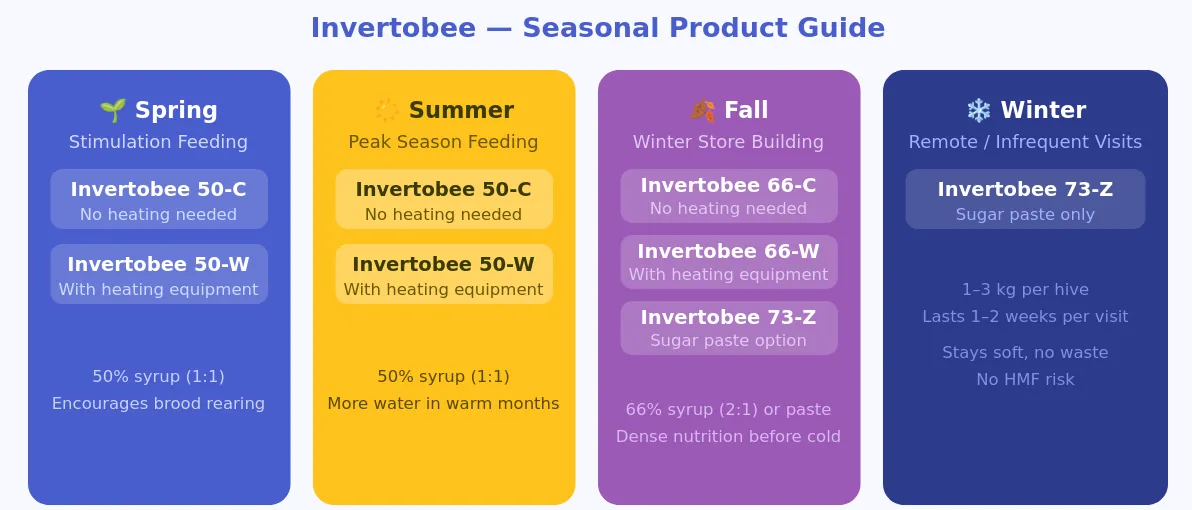
- Spring: 50-C or 50-W, 1:1 syrup to stimulate brood rearing.
- Summer: 50-C or 50-W, 1:1 syrup for peak-season feeding.
- Fall: 66-C or 66-W, 2:1 syrup to build winter stores, or 73-Z sugar paste.
- Winter: 73-Z sugar paste, for infrequent visits.
The infographic below shows the same plan.
How to Read the Product Names
- "-C" products (e.g., Invertobee 50-C) work at temperatures as low as 17–20°C, so no heating is needed.
- "-W" products (e.g., Invertobee 50-W, 66-W) require 50–60°C and suit operations with existing heating equipment.
- "50" products are formulated for 50% syrup (1:1 sugar to water), the thinner consistency suited to spring stimulation and brood rearing.
- "66" products are formulated for about 2:1 syrup (65–68% sugar), a denser feed for bees entering the cold months.
- Invertobee 73-Z is the invertase for sugar paste.
For the mixing steps, temperatures and costs of each product, see how to make invert syrup for bees with invertase.
Sugar Paste for Fall and Winter
When liquid syrup is impractical, because of remote locations or infrequent visits, sugar paste made with Invertobee 73-Z is a practical option. Paste made with the enzyme stays soft until it is eaten, while untreated paste hardens over time and gets abandoned by the colony.
A single 300 g pack of Invertobee 73-Z inverts 200 kg of syrup at 65–75% concentration, and yields approximately 800 kg of finished sugar paste, at an enzyme cost of €0.075 per kilogram. Supply 1–3 kg per hive and it typically lasts one to two weeks, which reduces the number of apiary visits.
Summary
Use the light 50% syrup (50-C or 50-W) to stimulate brood rearing in spring and for summer feeding, and concentrated syrup or paste to build winter stores.
Feeding amounts, timing and when to stop are covered in sugar syrup and paste for healthy, productive beehives.
The Invertobee range is below.
Related Products


